Render respray and colour changes in Wakefield
Render respray and colour changes in Wakefield
A respray changes the colour of render that is still sound, using a masonry coating sprayed or rolled over the existing surface. It does not replace the render or fix cracks, but on a wall that is firmly bonded and simply faded, stained or dated, it can transform the house at a fraction of the disruption of a re-render. Everything depends on the surface underneath being worth coating.

On this page
Is the render good enough to coat?
Start with the same checks a re-render would need. Tap the wall for hollow areas, look for cracks wider than hairline, and check for salts, flaking old paint and green or black growth. A coating is a thin film; it will not hold loose render on, and it will crack over moving cracks. Hollow patches and cracks are repaired first, and badly flaking old coatings are scraped back. Structherm's data sheet for its silicone masonry paint is typical: the surface has to be fully cured, dry and free from efflorescence, loose or friable material, algae, lichen and dust, and all repairs are carried out before application.
The type of render matters too. Sand-and-cement render that has been painted before is the usual candidate. Lime render needs a breathable limewash or mineral paint rather than a standard masonry coating, which the SPAB does not recommend on lime. Through-coloured monocouche and silicone renders can be coated, but check with the coating maker that the product suits that surface.
- Clean Washed down, with algae and mould treated and left to work.
- Repair first Cracks and hollow patches are repaired before any coating.
- Prime or stabilise Where the coating maker requires it on that surface.
- Coating Usually two coats of a breathable masonry or silicone coating.
The usual order of work. The survey and the chosen products decide the actual steps.
How a colour change is applied
Cleaning is the step people underestimate. Algae and dirt under a new coating will spoil it, so growth is killed with a cleaner suited to the coating; Structherm specifies its own algae cleaner before its paint. Pressure washing is used carefully, because a hard jet can drive water into cracks and damage soft or textured surfaces. Masking takes time because overspray carries, and everything that is not being coated is covered.
Most masonry coatings go on in two coats. Structherm's instructions, for example, call for a first coat diluted up to 10% with water, then an undiluted second coat once the first has dried, roughly 8–12 hours apart, by brush, roller or spray, and not below 5°C or above 30°C. The same paint batch should be used across whole elevations so there is no change in shade halfway along a wall.
Spraying is quick on large plain walls but needs calm weather and generous masking, because the mist drifts. Rolling is slower but easier to control beside a neighbour's house, a parked car or a conservatory roof. Many jobs use both: the open face sprayed, the edges, reveals and awkward corners rolled or brushed.
Repair cracks and hollow areas and let the repairs cure.
Treat algae and lichen with a suitable cleaner and wash the wall down.
Mask windows, doors, sills, brick and paving, and sheet vehicles and planting.
Apply any primer or stabiliser the coating system specifies.
Apply the first coat, often thinned slightly, and let it dry fully.
Apply the second coat undiluted, keeping a wet edge across each elevation.
Remove masking and check edges, reveals and sills.
Choosing the colour
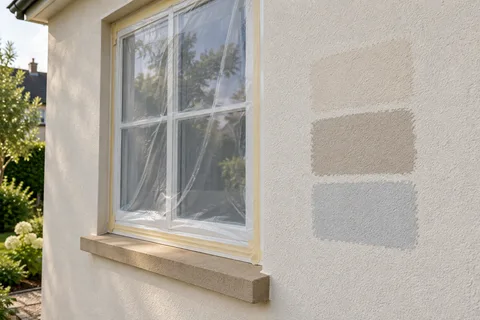
Colour on a small card looks darker and stronger once it covers a whole house, and a textured render shows a colour differently from a smooth chart. Ask for a sample patch on the wall itself, view it in morning and afternoon light, and look at it next to the roof, window frames and any brick or stone that stays. Remember the reveals, the plinth and the porch: decide whether they take the main colour or a contrast before work starts.
Painting in a Wakefield conservation area
Colour can be a planning question. Wakefield Council lists Article 4 directions in three conservation areas, Heath, St Johns and Whitwood Terrace, and the St John's appraisal refers to an Article 4 direction on paint schemes across that conservation area. If your house is on one of the affected property schedules, a change of exterior colour may need consent, so check with the council's conservation team before buying paint. The same appraisal describes some rendering on rear elevations as unsightly and inappropriate, which is worth knowing before planning any change to the outside of a house there.
Common questions
Will a new coating hide cracks?
Only fine, stable crazing. Anything wider, or any crack that moves, will come back through the coating, so cracks are repaired before the wall is painted.
How long does a respray last?
It depends on the coating, the exposure and how well the wall was prepared. Keep the product name and colour reference, follow the maker's care guidance and plan to recoat when the finish begins to chalk or fade.
See housing and planning information for Wakefield and nearby places, including the source and geography behind each figure.