Living in your house while it is being rendered
Living in your house while it is being rendered
Most render jobs are done with the family still at home. Knowing what each stage physically involves, which days are loud and dusty, when windows must stay shut and why the scaffold stays up after the wall looks finished, makes it much easier to plan school runs, deliveries, pets and work around the job.

On this page
Scaffold and sheeting
Whole-house rendering starts with scaffold, which changes how you use the outside of the house from the first day. Paths, the drive and the back door will have poles beside or across them, with boarded walkways overhead. Windows on scaffolded elevations can usually open, but a sheeted scaffold makes rooms darker and you will see people at upper windows during the day, so plan around bedrooms and home offices.
Sheeting is there for the render, not for appearance. K Rend's instructions for its TC 15 topcoat ask for fresh render to be protected from rain and from drying too fast, and the same applies to most systems, so sheets may stay on for weeks. They flap in the wind and darken the house, but taking them down early to let light in can spoil the finish.
For example, on a hypothetical house rendering job on a three-bedroom semi, the drive may be lost to the scaffold base and a skip for the first week, the side passage closed while the gable is stripped, and the front door kept usable through a protected walkway. Ask which entrance will stay open at each stage and where the skip, mixer and materials will stand.

| Stage | What you will notice |
|---|---|
| Scaffold | Poles across paths and drives, sheeting over windows |
| Stripping | Loud hammering, dust, rubble, closed windows |
| Repairs and beads | Quieter work, some drilling |
| Base coat | Mixing noise, wet render, masked frames |
| Finish | Spraying or trowelling, windows sealed |
| Curing | Quiet scaffold left standing, sheeting kept on |
Stripping: the loud, dusty days
Hacking off old render is the hardest stage to live with. A light breaker or a hammer and bolster on a wall is loud inside the house, the vibration carries through the structure, and dust gets everywhere. Keep windows and doors on that side closed, take down nets and pictures from the walls being stripped, and move anything fragile from shelves on those walls. Pets are usually happier away from the noisy side of the house, or away altogether for those days.
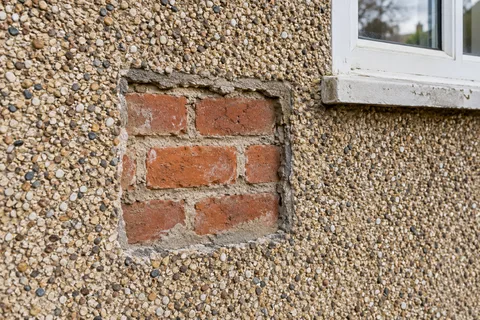
Rubble comes down chutes or in bags into the skip, and paths, gardens and cars nearby get dusty. Old render near windows sometimes drops onto sills and frames, which is why they are sheeted or boarded before stripping starts. Stripping is also when surprises appear, such as a cracked lintel or a bricked-up opening, so expect a conversation about extra repairs and perhaps a pause while they are agreed.
Base coat, finish and the quiet waits
Once the wall is bare, the work gets quieter. Repairs, repointing and fixing beads involve some drilling and cutting, then the base coat is mixed and trowelled or sprayed on. Frames, glass and doors are masked with film and tape, and those windows stay shut until the masking comes off. If the finish is sprayed, as K Rend's K Mono monocouche is, overspray carries, so cars, garden furniture and washing should be well out of the way.
Then come the waits that confuse people most. The wall can look finished while the system is still curing, and some systems need long gaps between coats; K Rend's TC 15 instructions ask for a freshly applied base coat to be left at least 14 days before the topcoat. During those gaps the scaffold stays up and the site goes quiet. Fresh render should not be touched, leaned on or hosed, and children's balls and bikes are best kept off it.
Inside, the house may feel stuffier than usual while frames are masked, because windows on that side cannot be opened. Keep extractor fans running in kitchens and bathrooms, open windows on elevations that are not being worked on, and expect the masking to come off as soon as each coat is safe to leave.
Weather delays, fittings and the end of the job
Rendering stops for weather. Heavy rain, frost and strong drying wind are all reasons not to apply render or coatings, and many products have temperature limits; Structherm's silicone masonry paint, for example, should not be applied below 5°C or above 30°C. A run of bad days can push the programme back, and the scaffold stays up while it waits.
Things fixed to the walls come off early and go back late. That can mean no outside light, satellite signal or doorbell for a while, and downpipes temporarily discharging into buckets or diverted. Ask when each item will be back and who will refit it, especially anything electrical.
The end of the job arrives in steps: last coat, curing, masking removed, fittings refitted, scaffold struck, then the clean-up of paths and gardens. Walk round with the contractor once the scaffold is down, because some details, such as the underside of sills and the bottom bead, are only easy to see from the ground.
Use the house rendering page to see the full sequence of work, and keep a note of which stages are still to come so the household knows what to expect next.
Neighbours, parking and shared walls
Rendering affects the people next door as well. On a semi or terrace, the scaffold may need to stand on or over their side, overspray and dust can reach their windows and car, and the render has to stop neatly at the party line. Talk to them before the scaffold arrives, agree where it can stand, and let them know which days will be loud. If a shared downpipe or gutter has to come off, agree when it goes back.
Parking is often the first casualty. A skip, the scaffold base and delivery pallets can take up the drive and part of the road, so plan where your own cars will go and when the skip will be swapped or collected.
Related services
How much the household notices depends on the job, from a small patch repair to a full re-render with the scaffold standing between coats. The Wakefield rendering homepage explains the different jobs and when each one is needed.
Common questions
Can the family stay in the house during stripping?
Usually, yes. It is loud and dusty for those days, so keep windows closed on the working side, protect belongings on those walls and consider working or staying elsewhere during the noisiest days if you can.
Why is the scaffold still up when the wall looks finished?
The render may still be curing, or a further coat may be due after a waiting period. Taking the scaffold and sheeting down early risks damaging fresh work.
See housing and planning information for Wakefield and nearby places, including the source and geography behind each figure.