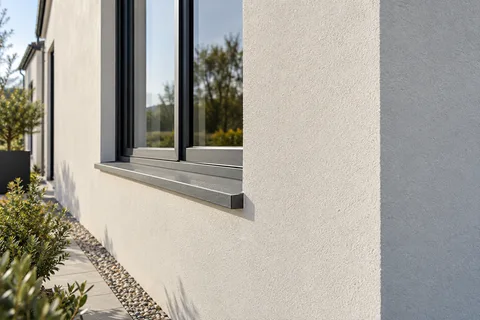
Monocouche rendering in Wakefield
Monocouche rendering in Wakefield
Monocouche means one coat. It is a factory-made, through-coloured cement-based render that is usually machine-sprayed on thick, levelled, left to firm up and then scraped to an open, slightly granular texture. Because the colour is in the mix, there is no separate paint or topcoat, and a scuff shows the same colour underneath. It is most at home on new blockwork, such as extensions and new-build houses.

On this page
How monocouche goes on
K Rend's K Mono shows what one coat means in practice. Its instructions call for the render to be sprayed on at 17–18mm in a single pass, levelled straight away with a straight edge or trowel, then left to set for between 3 and 24 hours depending on the backing and drying conditions before being scraped to the final texture, leaving a nominal 16mm. That is a much thicker layer than a thin-coat silicone, which is why monocouche can level a reasonably true block wall without a separate base coat.
The scraping stage is what gives the finish its character, and timing is everything. Scrape too early and the surface drags; leave it too long and it is hard to work. A whole elevation should be scraped in one session so the texture and shade are even. K Mono can be finished smooth on small areas such as quoins and window reveals, which gives a crisp border around openings.
Check the backing is clean, sound and free of anything that would stop adhesion.
Fix beads at edges, corners and above the DPC, and mask windows and doors against overspray.
Spray the render on at full thickness in one pass and rule it flat.
Leave it to set for the time the product and the weather allow.
Scrape the whole elevation to texture at the same stage.
Brush off the dust and protect the fresh render while it cures.
- Background Usually blockwork or brick; uneven or mixed walls may need a levelling coat.
- Beads and mesh Beads at corners, reveals and the base; mesh over junctions and lintels.
- Monocouche passes One through-coloured material, applied in passes to the specified thickness.
- Scraped surface Scraped once partly set, which removes the skin and leaves the texture.
Wall on the left, finish on the right. Not to scale: coats, thicknesses and primers follow the chosen manufacturer’s system and the condition of the wall.
Where it suits, and where it does not
Monocouche is a good match for new or nearly new blockwork, where the backing is even, clean and has never been painted. That covers many extensions, garages and new houses. It is less suited to old, uneven, patched or painted walls. K Rend describes K Mono as a one-coat finish over most moderate to low strength blockwork. On an older house with old paint, patches and uneven masonry, a thin-coat system over a proper base coat, or a traditional render, is often easier to get right.
It is also a cement-based, fairly rigid finish, so it is not the right choice for a traditional sandstone or lime-rendered wall that needs to breathe. Where an extension in monocouche meets an old stone house, the junction needs a designed joint rather than a continuous skim across two very different walls.
Details that need care
Overspray is the first risk. The render is pumped under pressure, and K Rend advises polythene sheeting over doors, windows and other features. Beads come next: a bell-cast bead above the DPC so the render does not bridge it, stop beads where it meets brick or timber, and corner beads on external angles. Where the new wall meets an older one, or where a long elevation needs a movement joint, the joint should be planned into the layout, not hidden by spraying across it.
Weather matters more than with paint because the render has to set and cure at full thickness. Spraying in frost, rain or hot drying wind risks a weak bond, surface cracking or blotchy colour, so exposed elevations are often sheeted while the render firms up.
Looking after a monocouche wall
Through-coloured render does not need repainting to stay the same colour, but it does weather. Light colours can pick up dirt below sills and copings, and shaded walls can grow algae. Gentle cleaning suited to the finish is better than a pressure washer, which can roughen the scraped texture. Small chips can be patched, but a patch on a weathered wall rarely disappears completely, so keep the product name and colour reference for later repairs.
Common questions
Does one coat mean one visit?
No. One coat describes the render, not the job. Beads, masking, spraying, the setting period, scraping and curing all take their own time, and weather can stop work.
Monocouche or silicone for a new extension?
Both can work on new blockwork. Monocouche gives a thicker scraped finish in one material; silicone gives a finer texture over a meshed base coat. The deciding points are usually the texture you want and how the extension meets the house.
See housing and planning information for Wakefield and nearby places, including the source and geography behind each figure.