Silicone or monocouche for a Wakefield house?
Silicone or monocouche for a Wakefield house?
Silicone and monocouche are both through-coloured renders, so neither needs painting, and in a photograph they can look alike. On the wall they are built in opposite ways: one is a thin resin topcoat on a meshed base coat, the other a thick cement render scraped to texture. This article compares how each is built, how it looks close up, how it ages and how the choice plays out on a real house.

On this page
What each material actually is
Both are factory-made and coloured all the way through, so neither needs painting, but they are built in opposite ways. In the Weber comparison linked below, silicone is a decorative topcoat used within a system, while monocouche is a through-coloured render applied as the main body of the finish. In plain terms, silicone is a decorative topcoat only a millimetre or two thick that depends on the base coat under it, and monocouche is a through-coloured render thick enough to level and weatherproof a block wall on its own.
K Rend's own products show the difference in numbers. Its silicone route starts with the HP12 base coat at a nominal 4–6mm, with alkali-resistant mesh at stress points such as reveals. Fresh base coats are left at least 14 days, Primer TC follows and dries for 24 hours, and only then is the TC 15 topcoat floated on to the depth of its grain and rubbed up. Three products, three visits to each wall, and the weeks between them.
K Mono works the other way round. It is sprayed on at 17–18mm in a single pass, ruled flat, left for between 3 and 24 hours depending on the backing and the weather, then scraped back to around 16mm. There is no separate base coat, which makes it quick on clean new blockwork and much less forgiving on an old, painted or patched wall.
Sand-and-cement render often appears in the same conversation. It is mixed on site, applied as a scratched first coat and a floated second coat, then painted. It is simple to patch, but its colour depends on the paint, which has to be renewed.
If insulation might be added, the choice narrows. Structherm's NSC2 insulation system, for example, lists acrylic, silicone, dash and brick-effect finishes over its meshed base coat. A decorative finish is never a substitute for a designed insulation assembly, which the EWI page explains in more detail.


| Thin-coat silicone (K Rend TC 15) | Monocouche (K Rend K Mono) | |
|---|---|---|
| Layers | Meshed base coat, primer, topcoat | One through-coloured coat |
| Thickness | Base coat nominal 4-6mm; topcoat to its 1.5mm grain | 17-18mm applied, scraped to about 16mm |
| Waiting | Fresh base coat 14 days; primer 24 hours | 3-24 hours before scraping |
| Texture | Fine grain, rubbed up with a plastic float | Open scraped surface |
How the two finishes look close up
Up close the difference is easy to see. A silicone topcoat floated to the depth of its grain and rubbed up with a plastic float gives an even, sandpaper-like surface; K Rend's TC 15 has a 1.5mm grain, and a coarser grade reads rougher from the street. A scraped monocouche has a more open, slightly granular surface left by the scraping tool, with a softer look in low light.
Edges differ as well. K Rend says K Mono can be finished smooth on small areas such as quoins and window reveals, which gives a scraped wall a crisp border around each opening. A silicone finish can carry the same grain into the reveals, with beads giving the straight lines at corners and stops.
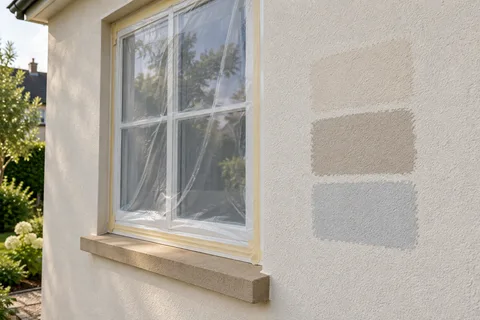
Judge either one on a sample of the real product rather than a printed card, set against the brick, frames and roof that will stay and seen from the pavement as well as close to. Wet render looks darker than dry, so wait until a sample has dried before deciding.
How each one ages and how it is repaired
A silicone topcoat sheds rain well, and K Rend says its TC 15 contains a biocide against moulds and algae. Its weakness is thinness. A knock from a ladder or a wheelie bin can break through to the primer, and the repair means patching the base coat if needed, priming, and re-floating topcoat over an area large enough to blend, ideally to a corner, bead or downpipe. Fresh grain beside weathered grain often shows for a while.
Monocouche is a thick coat, so a knock that would break a silicone finish may only bruise the surface. Repairs are still visible, because new render beside aged render differs in shade, and the scraped texture has to be recreated by hand. Light colours on both systems pick up grime under sills and copings and grow algae on shaded walls. A soft wash with a product suited to the finish is kinder than a pressure washer, which can roughen a scraped surface or strip grain from a thin coat.
A worked example: a painted front and a new extension
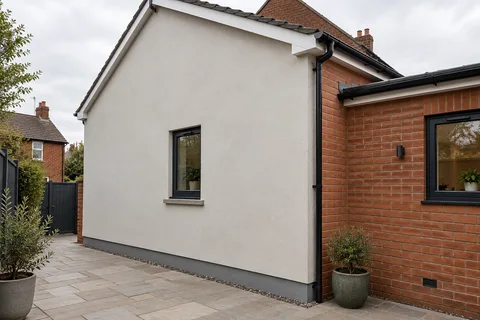
For example, take a hypothetical semi with an old painted sand-and-cement render on the front and a new blockwork extension at the side. The owner likes a pale colour and is weighing up silicone against monocouche. What matters is what each route does to the two walls, not the colour card.
On the extension, both routes are straightforward. The silicone route puts a meshed base coat on the blocks, waits for it to cure, primes and then floats on the topcoat. The monocouche route sprays the blockwork directly at full thickness and scrapes it the same day or the next. Either way the extension needs beads at the DPC, at the corners and where it meets the house.
The painted front is where the routes converge. K Rend lists unpainted render and brickwork among the backgrounds for its HP12 base coat, and K Mono is described as a finish over blockwork, so neither system goes straight over flaking old paint. The front will need the paint and any hollow render taking off, and possibly a full strip back to brick, before either system can start. The tap test decides how much comes off.
So the real choice is texture and timing. Silicone gives a fine, even grain and a slower programme because of the curing waits; monocouche gives a thicker scraped finish in fewer steps on the new wall. If both walls must look identical, use one system on both and finish each elevation in one session. If the extension may be insulated later, silicone keeps that option simpler.
Whatever is chosen, ask what preparation is included for each wall, because the stripping and repair of the old front will often be the largest part of the work.
Related services
Neither finish is needed if the existing render can be repaired and recoated. The Wakefield rendering homepage explains how the condition of a wall points to repair, a new colour or a full re-render, which is the decision to make before choosing between these two systems.
See housing and planning information for Wakefield and nearby places, including the source and geography behind each figure.